

Historically, the promotional industry operated on a model of planned obsolescence. Merch was designed to be a temporary token, used to preserve a moment and eventually be discarded. When sustainability first became a trend, many brands simply added a thin veneer of eco-friendliness to this disposable model. But a notebook that falls apart in a month is still future landfill waste, regardless of its cover material.
In 2026, the era of greenwashing is ending. We are moving beyond a product-first mindset toward a permanent shift in brand narrative.
The Evolution of Value: Breaking the Disposable Stigma
Sustainability in the promotional industry has shifted from doing less harm to doing measurable good. In 2026, a sustainable program is no longer defined by the absence of plastic, but by the presence of a measurable, positive footprint.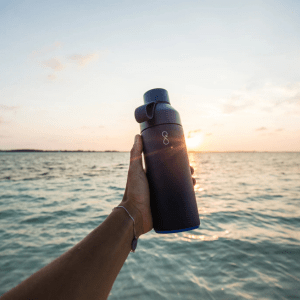
True impact is achieved through three core pillars of modern circularity:
-
-
-
-
-
-
-
-
-
-
-
-
-
- Upcycling: We’ve moved beyond “recycled content” to high-performance re-engineering. This isn’t about second-best materials; it’s about retail-grade quality born from unconventional sources.
- The Give-Back Loop: The best sustainable item carries a trackable story. Whether it is a specific number of bottles pulled from the water or a verified carbon offset, the impact is a data point rather than a vague promise.
- Designed for Disassembly: True circularity means planning for the end at the beginning. We prioritize products built to be unzipped, unbolted, and returned to the manufacturing loop, ensuring your brand’s legacy never hits a landfill.
-
-
-
-
-
-
-
-
-
-
-
-
Ultimately, these strategies shift the focus from consumption to contribution, transforming your promotional strategy into a gateway for the circular economy where your brand’s presence actively fuels environmental renewal.
What is the Circular Economy in Branded Merchandise?
The circular economy is a systemic approach to economic development designed to benefit businesses, society, and the environment. In contrast to the “take-make-waste” linear model, a circular economy is regenerative. It aims to decouple growth from the consumption of finite resources.
Giving Old Gear a New Life: Why Dead Stock Impacts Scope 3 Emissions
In the corporate world, dead stock is often a byproduct of change. When a company rebrands, undergoes an acquisition, or wraps a campaign, thousands of premium assets are suddenly reclassified as liabilities. This leaves organizations with two poor options: haul the gear to a landfill or let it sit as permanent inventory.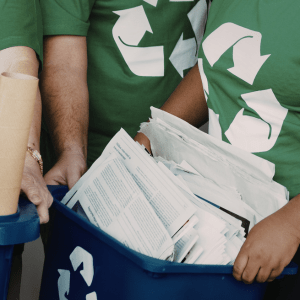
Both choices undermine sustainability claims. Keeping items in storage is a direct hit to your carbon footprint. Paying to store obsolete products in climate-controlled warehouses inflates your Scope 3 emissions, the indirect emissions across your entire value chain.
- The Scope 3 Inflator: You cannot claim Net Zero while powering a warehouse full of products destined for the dust heap.
- The Landfill Eventuality: Landfills are the ultimate failure of a linear economy. When textiles and electronics sit in a landfill, they release methane and toxins.
- Wasted Embodied Carbon: Every item required water and energy to manufacture. If that item is never used, that entire environmental investment is discarded.
How to Manage Excess Inventory: BAMKO’s Recovery Ecosystem
At BAMKO, we have eliminated the operational “dead end” of dead stock. By integrating specialized recovery partners into our supply chain, we move stagnant inventory back into a productive, circular loop.
Gomi: Turning Non-Recyclable Plastic into High-Performance Tech
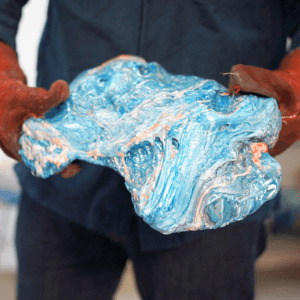 Our partnership with Gomi offers high-performance technology made from materials the world gave up on. Based in Brighton, UK, Gomi treats trash as a premium raw material.
-
-
-
-
-
-
-
-
-
-
-
-
-
- Handcrafted Waste Plastics: Gomi transforms flexible plastics like bubble wrap and shopping bags into a unique, marble-textured material. Each speaker saves the equivalent of 44 plastic bags from the landfill.
- Second-Life Power: Lithium mining is environmentally destructive. Gomi salvages healthy batteries from damaged e-bikes to power their audio equipment.
- Modular by Design: Most tech is glued shut and designed to be disposable. Gomi products are modular and can be repaired or upgraded in minutes.
-
-
-
-
-
-
-
-
-
-
-
-
SwagCycle: Turning Obsolete into Opportunity
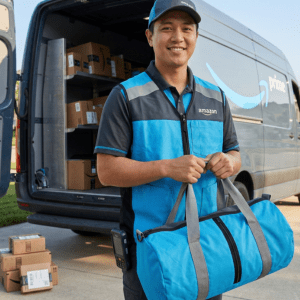 SwagCycle provides a secure solution for managing unwanted inventory. They offer a documented strategy that protects brand integrity while salvaging material value.
- Charitable Matching: For usable items, SwagCycle leverages a network of vetted nonprofits like the YMCA. This ensures surplus goods reach communities in need.
- Textile-to-Textile Recycling: When logos prevent items from re-entering the market, SwagCycle utilizes a “shred-and-spin” process. Uniforms are reduced to raw fiber and reborn as industrial insulation or new yarn.
- The Impact Receipt: You receive a detailed report quantifying exactly how many pounds of material were diverted from landfills, providing the data your ESG team needs.
- Discover how we turned outdated Amazon driver vests into durable duffel bags, giving the unwanted material a new purpose.
Beyond Materials: The Social Impact of Circularity
A true circular economy is also about the human life cycle behind every product. While recycling solves physical waste, impact brands solve systemic vulnerability.
Parker Clay: How “Trade, Not Aid” Creates Sustainable Employment
 Parker Clay provides premium leather goods that actively rebuild communities. As a top-rated B-Corp, they prove that a smarter supply chain can be an engine for social restoration.
-
-
-
-
-
-
-
-
-
-
-
-
-
- The Center of Excellence: Parker Clay operates a facility in Addis Ababa, Ethiopia, providing a path out of the commercial sex trade for at-risk women through living wages and healthcare.
- Empowerment Hours: Every product is labeled with the specific number of “Empowerment Hours” it generated, allowing your brand to quantify its contribution to social equity.
- Sustainable Sourcing: They utilize local Ethiopian leather from sustainable tanneries. Keeping production local reduces transportation emissions and ensures economic benefits stay within the community.
-
-
-
-
-
-
-
-
-
-
-
-
RIPL: Providing Metrics for Radical Transparency
RIPL turns everyday essentials into verified data points for restoration. While they are widely known for their drinkware, the RIPL ecosystem spans multiple categories, with each product aligned with a distinct impact goal. This allows you to select the specific environmental or social cause, from ocean cleaning to reforestation, that resonates most with your audience.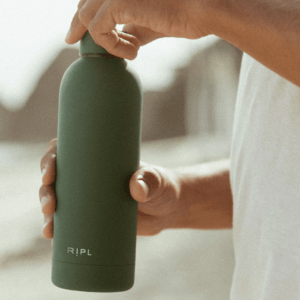 Their core mission operates on a simple, powerful scale: 1 Bottle = 1 Day of Employment.
- Social ROI: Every bottle funds a full day of work for an individual in a coastal community to collect plastic from beaches and rivers, directly fighting ocean pollution while providing a living wage.
- The Digital Story: Every product includes a QR code that leads to a dedicated impact site. This allows your audience to see the real-time story and verified data of the specific project their item funded.
- Retail-Grade Performance: Beyond the mission, the quality is uncompromising. RIPL bottles are made from vacuum-insulated 18/8 stainless steel, keeping drinks cold for 24 hours or hot for 12.
- Discover how MetLife and BAMKO built an annual employee appreciation program through RIPL that drives significant impact and employee retention.
How Your Merch Becomes Your Brand Legacy
The products you brand tell the world what you value. By partnering with BAMKO, you tap into a supply chain that prioritizes the planet and its people.
When you choose these partners, the marketing happens twice: first, when the recipient receives a world-class product, and second, when they realize they have become part of a global solution. This is the evolution of merch, transforming a marketing budget into a tool for global restoration.
Ready to close the loop on your next project? Let’s talk about making your merchandise part of the circular economy.