

In most enterprise procurement portfolios, brand merchandise is the “final frontier” of fragmentation. While high-spend categories like raw materials or IT are tightly managed, brand engagement spend on things like merchandise, employee gifts, uniforms, and other promotional items remains a high-volume, low-visibility “tail spend” category.
Most organizations believe they are saving money by bidding out individual projects to a pool of 50 or 100 vendors. In reality, this tactical approach creates a complexity tax. A complexity tax is a 15–20% value leak caused by administrative friction, logistical waste, and a lack of cross-functional alignment.
This challenge was the central focus of the session, The Last Frontier of Tail Spend: Reclaiming 10-20% Inefficiency in Brand Engagement Category, presented by BAMKO experts Dan Lunoe, Kurt Varangu, and Pat DePirro at the ISM World 2026 Supply Chain Conference. By focusing on the lowest unit price, procurement leaders often miss the massive overhead leaking out of the bottom of the supply chain
To recover this capital, organizations are shifting from transactional vendor management to partnering with a Managed Service Provider (MSP).
What is a Managed Service Provider?
In the brand engagement category, a managed service provider (MSP) acts as the strategic architect for your entire branded ecosystem. Rather than simply fulfilling orders, an MSP takes end-to-end accountability, integrating creative design, global logistics, inventory risk, and compliance under a single governance structure, backed by proprietary technology with full spend transparency. This shift moves the “burden of execution” from your internal team to an expert partner, allowing your staff to focus on high-value strategy rather than chasing thousands of low-dollar purchase orders.
At BAMKO, we help leadership reclaim that 20% by transforming these fragmented programs into a streamlined, managed engine.
The Iceberg Effect: Uncovering the Hidden Cost of Fragmented Procurement
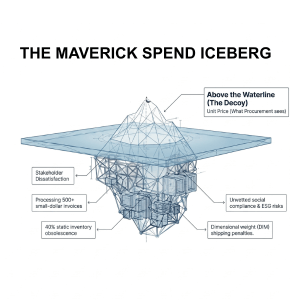
The fundamental challenge in procurement is the “Iceberg Effect.” Most professionals are trained to prioritize the costs above the waterline: the quoted unit price of a hoodie or a notebook. This “decoy” price looks favorable on a spreadsheet, but it ignores the submerged costs of execution. Below the waterline, the complexity tax compounds through administrative friction, where the cost of processing endless small-dollar invoices often exceeds the value of the goods themselves.
-
-
-
-
-
-
-
-
-
-
-
-
- The Hidden Overhead: The cost of processing 500+ small-dollar invoices from dozens of localized vendors often exceeds a single monthly invoice. This helps our enterprise clients free up internal time and resources, so they can do more with less oversight.
- The Obsolescence Trap: Up to 40% of static inventory eventually becomes obsolete, sitting in warehouses until it’s eventually thrown away.
- The Logistics Leak: Fragmented “parcel only” shipping and Dimensional Weight (DIM) shipping penalties that can double the landed cost of an item.
- The Compliance Gap: Hidden ESG risks and unvetted social compliance issues that threaten the company’s reputation, or lead to stakeholder dissatisfaction.
-
-
-
-
-
-
-
-
-
-
-
Bridging the Gap: From Passive Purchasing to Active Management
Identifying these hidden costs is only the first step; the challenge for procurement is moving from a reactive “order-taking” posture to a proactive management strategy. This is where the Managed Services model pivots. While a traditional vendor waits for a purchase order to execute a pre-existing (and often flawed) concept, a strategic MSP like BAMKO enters the lifecycle much earlier.
By integrating our expertise into the upstream planning phases, we transition the brand engagement category from a series of disconnected transactions into a controlled, predictable workflow. This ensures that every dollar spent is optimized for global distribution and long-term utility, rather than just the immediate needs of a single campaign.
The “Silo Tax” and the High Cost of Creative Misalignment
 The most significant drain on a procurement budget often stems from a disconnect between Creative and Supply Chain departments. When creative teams design for “impact” without an understanding of manufacturing constraints, the result is a Design for Manufacturing (DFM) failure. This is an expensive mistake. When a design isn’t engineered for production from day one, organizations face five times the tooling costs for late-stage engineering fixes.
Not to mention, nearly 30% of agency designs are eventually discarded because they are simply not producible at scale. BAMKO eliminates this silo tax by unifying these functions. We don’t just design artwork; we design for our global supply chain, ensuring every concept is engineered for cost-efficiency and scalability before a single dollar is spent on production.
From Tactical Purchasing to Operational Integrity
True value realization is found in operational integrity, not one-off bargains. In a transactional model, procurement leaders must manage an unruly stable of localized vendors, leading to high maverick spend and inconsistent quality. By consolidating under a managed service provider model, you transition from managing vendors to mastering a category.
BAMKO provides the digital visibility required to report back to the board with confidence. Through integrated reporting, we provide real-time visibility into spend and inventory turnover, backed by automated compliance tracking. This ensures every item in your program meets your ESG and safety standards, effectively closing the compliance gap that exists in unvetted, fragmented supply chains.
Purpose-Driven Procurement: The New Bottom Line
 We believe in “impact over items.” In the modern corporate environment, merchandise should reinforce your company’s ESG mission, telling a story of doing good rather than just giving out “stuff.” Through our partnership with brands like RIPL, we shift the narrative from consumption to contribution. That way, your recipient isn’t just receiving a branded item, but becoming part of a massive impact.
Imagine the power of a procurement report that quantifies a legacy: demonstrating to stakeholders that a single employee engagement program prevented 4 million plastic bottles from entering the ocean. This is the bridge between the CFO’s office and the Marketing department. By consolidating your brand programs under BAMKO, you achieve significant cost reduction, ironclad brand protection, and a streamlined process that turns the Complexity Tax into a strategic advantage.
Comparative Analysis: Tactical Vendor Bidding vs. Strategic Managed Services
To quantify the shift from fragmented purchasing to operational excellence, we must look at the structural differences between a traditional vendor relationship and an MSP partnership. The following comparison highlights the specific levers, from logistical consolidation to administrative streamlining, that allow organizations to reclaim the 20% “Silo Tax” and convert it into measurable bottom-line savings.
| Feature | Transactional Vendor Model | BAMKO Managed Service Model |
| Vendor Ecosystem | 50–200+ unvetted, localized vendors | One strategic global partner |
| Logistics Strategy | Fragmented, high-cost parcel shipping | Optimized, kitted & consolidated freight |
| Financial Workflow | Thousands of high-friction, low-dollar POs | One automated, consolidated monthly invoice |
| Visibility & Data | Dark spend with no centralized reporting | Real-time spend and inventory transparency |
| Operational Result | High maverick spend and value leak | 30% lower unit costs & 15% waste reduction |
By consolidating the vendor ecosystem and automating the invoicing lifecycle, procurement teams move from “managing fires” to “mastering a category,” resulting in a program that is finally scalable, compliant, and cost-predictable.
Transforming Procurement from a Cost Center to a Competitive Advantage
The transition to a Managed Services Provider (MSP) model is more than a tactical procurement pivot; it is a commitment to operational excellence. By eliminating the 20% “Silo Tax,” organizations create a vital bridge between the CFO’s office and the Marketing department, aligning rigorous fiscal discipline with high-impact brand storytelling.
In a global economy where supply chain efficiency is a primary competitive differentiator, the goal is no longer to manage a stable of vendors, but to master the entire category. This is the BAMKO difference. We move beyond the transaction to deliver a more profitable, sustainable, and scalable framework for global brand engagement.
Ready to Reclaim Your 20%?
Is your brand merchandise program suffering from fragmentation and “tail spend” leakage? Let’s identify exactly where we can consolidate your spend and streamline your global operations.
Contact BAMKO Today to schedule a procurement audit and discover how our Managed Services model can turn your complexity tax into a strategic advantage.
Optimizing Brand Procurement FAQ