

The ripple effects of newly implemented tariffs are creating complexities in the supply chain, leaving many businesses wondering about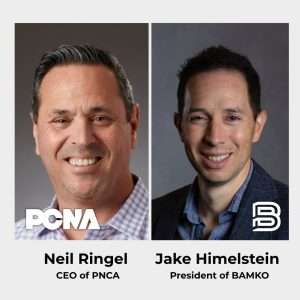 inventory, pricing, and the best path forward for their branding initiatives. To shed light on these evolving challenges, BAMKO recently hosted a webinar, featuring a Q&A session with BAMKO President Jake Himelstein and special guest Neil Ringel, CEO of PCNA.
As one of the industry’s largest suppliers, PCNA plays a vital role as a key partner for BAMKO. Our collaboration facilitates thousands of domestic projects annually, allowing us to provide swift turnaround times for customized promotional products. Building on this strong foundation of partnership and shared expertise, Neil and Jake are uniquely positioned to dissect the complexities introduced by the current tariff landscape.
This powerhouse duo offers an invaluable perspective for navigating these challenges. We’re breaking down their conversation on the immediate impacts of tariffs and sharing their actionable advice for promotional product buyers seeking to stay ahead. Read more to catch the highlights, or, check out the full webinar recording for more insights!
Q: How are tariffs impacting the promo supply chain, more specifically, the hard goods portion, which is historically based in China?
“Tariffs are certainly having a large impact on the hard goods space since much of what gets imported today across our industry comes from China, where tariffs are now exceeding 145%,” said Neil. This substantial increase represents a fundamental shift in the cost structure for a vast array of promotional items, from tech gadgets to drinkware and beyond.
Adding to the complexity is the fluid nature of the current trade landscape. While there has been reporting that tariffs might come down, the reality is that businesses are operating amidst considerable uncertainty. Regardless of potential future adjustments, the present reality of tariffs at their current levels poses a significant challenge for companies across the industry.
Q: How has PNCA adapted its sourcing and inventory strategies? Are you seeing any longer-lasting shifts away from China?
As Neil explained, “One of the lessons we learned coming out of the COVID crisis was the need for diversification of our supply chain. I think we all remember the uncertainty and factory closures and all that came with COVID.” Neil states that their team has been very successful in finding sources off the mainland that meet both their quality and compliance standards, a process that began even before the current tariff pressures. However, Neil was also clear that a complete shift away from China isn’t instantaneous or universally applicable: “Not everything we source has a source away from China, and that’s going to lead to increased costs.”
Despite this, the current tariff levels are making alternative sourcing locations increasingly attractive. “It is an invaluable advantage to have diversified outside of China early,” said Jake. “Those businesses that are looking to diversify now, quite honestly, they’re not getting capacity.” Neil corroborated this, emphasizing the broader competition for these alternative manufacturing hubs, stating, “it’s not just the promotional products companies rushing to these suppliers. It’s Target and Walmart, and people with very deep pockets and very big needs. So these factories with limited capacity are seeing excessive demand.”
BAMKO and PNCA’s proactive diversification approaches are coupled with a strategic approach to inventory. Addressing the concerns of BAMKO clients and prospects worried about potential shortages, particularly for the crucial Q4 and holiday seasons, Neil offered reassurance. “We saw this risk long before the initial tariffs went forward. And we bought where we could. So, we have deep inventory onshore here in the United States.”
Neil also cautioned about potential disruptions ahead, stating, “In the coming months, there’s a possibility for delays and supply chain disruption… Eventually, everybody’s going to want to get everything on the same boat at the same time, clearing the same port. It’s going to cause disruptions, the same way COVID did in 2020 and 2021.” This potential bottleneck underscores the importance of PCNA and BAMKO’s current inventory strategies and highlights why Neil strongly encourages buyers to “consider accelerating purchases for Q4, both to ensure availability of product, but also stability of price.”
Q: How should customers think about pricing? Are we seeing cost increases across the board, or anticipating them in the future?
“The fact of the matter is that tariffs mean price increases,” said Neil. “This fundamental reality points towards an inevitable upward trend in costs.” Neil anticipates that returning to previous tariff levels is unlikely, and PCNA is already experiencing increased expenses with every incoming container, regardless of its origin. This global rise in tariffs makes it a foregone conclusion that prices will ultimately rise throughout the promotional products industry. This mirrors the broader consumer market, where retailers are facing similar pressures and are expected to adjust their pricing accordingly.
Given this trajectory, the strategic move for buyers is to act sooner rather than later. Neil encourages customers to take advantage of current pricing levels. The longer the tariffs remain in effect, the more deeply these increased costs will permeate the supply chain, leading to higher prices down the line. By making purchasing decisions now, brands can potentially mitigate some of the impending price increases.
Flexibility in product selection can also play a crucial role in navigating this environment. While price increases may be unavoidable on certain items, being open to alternative products or slightly different specifications could offer opportunities to manage overall costs. The key takeaway is that the current tariff landscape strongly suggests that waiting to purchase will likely result in higher expenses, making proactive and flexible buying strategies essential.
Q: In times like these, what separates a company that’s going to weather the storm from the ones that aren’t?
In times of significant industry shifts, the question of who to partner with becomes paramount. Buyers understandably worry about the reliability of their suppliers – will they have sufficient stock? Can they consistently fulfill inventory needs? Will they even remain a stable business in the face of prolonged challenges? Neil acknowledged the gravity of these concerns, stating, “I view this scenario as something that’s going to test and reshape our industry, perhaps for a few months, perhaps for a few years.”
His advice for navigating this uncertainty is clear: prioritize partners who have demonstrated foresight and invested in building resilient supply chains. Specifically, Neil urged buyers to “work with companies like BAMKO, like PCNA, that have invested resources in finding alternatives to China.” He emphasized that companies just beginning to diversify their sourcing now are likely to face significant hurdles, finding themselves “last in line and not in a good position.”
“Fair or unfair, the larger players and the ones that have deeper inventory and are more established fare better,” said Jake. “And that is true through any sort of economic recession or crisis. And I think we’re seeing the same thing here.”
The partnership between BAMKO and PCNA underscores the value of aligning with organizations that possess both substantial inventory and the agility to source beyond a single geographical location – qualities that are proving essential for weathering the current economic climate and ensuring consistent service for end-user customers.
Planning and Partnership in a Changing Market
These insights paint a clear picture of the challenges and necessary adaptations within the promotional products industry due to evolving tariffs. We want to emphasize the importance of proactive planning, embracing flexibility in product choices, and partnering with resourceful suppliers who have strategically diversified their supply chains.
To gain a comprehensive understanding of navigating these shifting tides and developing a resilient strategy for your branded merchandise campaigns, we encourage you to watch the full recording of our BAMKO Insights Part Two webinar.
Our expert panel provides a clear path to remediating tariff risk, ensuring supply chain stability, and making informed decisions to protect your brand. Watch now to unlock actionable insights and learn how proactive ordering can safeguard your future merchandise needs
Supply Chain Tariffs & Promotional Merchandise FAQ