

In the promotional products industry, the distance between a “cool idea” and a “responsible product” is wider than most realize. It is a gap filled with complex jargon and compliance triggers that can put a brand’s reputation at risk.
At BAMKO, that gap is guarded by Jodi Gruder, Global Director of Compliance & Sustainability. With 30 years of experience, Jodi doesn’t just check boxes; she acts as an engineer, a teacher, and the ultimate gatekeeper to sustainable, safe, and compliant products for all of BAMKO’s clients.
In this Q&A, we dive into the science of sustainable sourcing. Jodi pulls back the curtain on how she balances the rigid world of safety, the evolving landscape of sustainability, and the trending products that make a real impact for global brands.
Q: From the moment a salesperson says, “I have a new idea,” what requirements must that item pass through before it’s cleared? How do you walk the line between vetting for basic safety versus sustainability?
 Jodi: Every new idea for a fun, cool product must pass through specific layers of verification for safety, compliance, and sustainability standards, which encompass fair labor practices, carbon emissions disclosure, and source material substantiation. In my role, I’m ensuring that every ‘great idea’ is also a ‘responsible product.’
When it comes to product safety, I am constantly vetting new products, testing for lead, phthalates, and physical hazards. Sustainability, however, requires a different kind of vigilance. I am keenly aware of ‘greenwashing,’ or the practice of making a product appear more environmentally friendly than it actually is. To fight this, we rely on substantiation. We don’t take a supplier’s word for it; we ask for documentation. My favorite expression is always, “trust but verify.”
Q: BAMKO works with a vast global network. How do you ensure we are only partnering with vendors who can actually back up their claims?
Jodi: My top priority is ensuring that we work with approved, reputable suppliers. This isn’t just a preference; it’s a non-negotiable standard. We use suppliers who can provide a paper trail for everything they produce. If a vendor claims a bag is made from recycled ocean plastic, I don’t take their word for it;I require the specific material certifications to prove it. We prioritize manufacturers who have built their business models on transparency and often partner with organizations that champion ‘give-back’ elements, such as RIPL (a partner focused on circularity and ocean plastic recovery).
However, I work to provide a ‘reality check’ for our sales team: while all our suppliers are approved, reputable, and capable of providing documentation, sustainability itself is often a trickle-down effect. Depending on a campaign’s specific budget and goals, we can dial the level of sustainability assessment up or down, but the baseline of safety, ethical partnership, and reputable sourcing is never up for negotiation.
Q: Should a market-ready product not meet a client’s sustainability goal, how does BAMKO’s custom manufacturing change the conversation?
Jodi: This is where we really pivot from being a distributor to being an engineer. In this industry, something new and trendy hits the market every week, but often those ‘cool’ items don’t align with a client’s specific organizational standards or their public sustainability promise. When that happens, we don’t just say ‘no, we change the blueprint.
Because we have the unique ability to manufacture through our own factories, we can custom-build a similar product from the ground up using compliant, sustainable materials. We can swap out virgin plastics (brand-new plastics created from oil or gas) for upcycled or certified recycled alternatives. While this ‘proof of concept’ phase is more complex and can carry a higher price tag than a stock item, it gives us total control over the supply chain and the environmental impact.
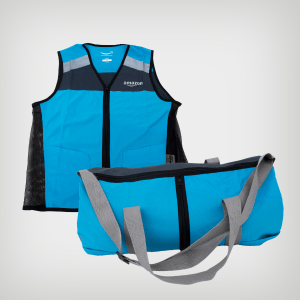
We can even take it a step further through true circularity by upcycling a brand’s own discarded merchandise into something entirely new. A great example of this was a project we did for Amazon: we took old driver vests that were headed for a landfill and re-engineered them into custom duffel bags within our own factories. It turned discarded product into a powerful PR story and a high-quality finished good. It’s about finding a way to say ‘yes’ to the trend without compromising the client’s integrity.
Q: Global compliance is increasingly a game of data management. How is BAMKO tracking its footprint and moving toward Science-Based Targets?
Jodi: “I’m constantly learning in this industry; attending webinars, conferences, and listening to the world’s leading experts. It’s a fast-moving space. Every June, I work to compile and release our CDP Reporting Data, which integrates into our overall corporate ESG (Environmental, Social, and Governance) report.
But I’m not just looking backward at what we did, and reviewing what we do; I’m looking forward. This year, I’m working on an initiative to implement science-based targets into our future ESG reports. These are carbon reduction targets that are considered ‘science-based’ because they align with what the latest climate science deems necessary to meet the goals of the Paris Agreement; limiting global warming to well-below 2°C.
Q: What are the biggest red flags in the industry today regarding “eco-friendly” claims?
Jodi: To me, the biggest red flag is greenwashing fueled by unverified claims. The danger lies in the gap between a marketing promise and a product’s actual lifecycle; if you can’t substantiate the impact from start to finish, it’s just a narrative.
The easiest way to accidentally greenwash is to prioritize buzzwords over the high cost of real sustainability. Fifteen years ago, we were manually ripping up old apparel to re-spin it into new thread, but the labor and demand eventually outpaced our systems. It taught us a vital lesson: true sustainability isn’t just a label; it requires significant investment in transparent supply chains to ensure claims are grounded in reality, not just trends.
Q: What material innovations are you actually excited about right now?
Jodi: I’m really excited about the potential of creating a true circular economy, particularly in how we address the global plastic crisis. We are seeing significant evolution in materials like Polypropylene; the updates in non-woven designs are opening new doors for high-performance, sustainable applications.
The real breakthrough is the concept of “designed for deconstruction.” I recently saw display cases where every component was engineered to be effortlessly taken apart at the end of its life. This ensures that recyclability is a functional reality where materials are captured and processed back into the supply chain rather than just being a hopeful label.
It was a total aha moment. It proved that a product built for disassembly can be premium, sleek, and high-end. Seeing that level of craftsmanship proves we don’t have to sacrifice luxury aesthetics for responsible engineering. When we design for deconstruction from the start, high-end design and environmental integrity finally speak the same language.
Q: Looking back at your work, what is the most rewarding project you’ve personally brought to life at BAMKO?
Jodi: “The ‘Amazon Vest’ project is my favorite. Taking a finished (yet discarded) product, a driver’s vest, and working with the factory to deconstruct and re-imagine it into a functional and stylish duffel bag was a massive technical challenge. I worked really closely with this project, working with our factory to oversee the placement of the zippers and ensure the integrity of the material remained intact. It was complicated and required a lot of trial and error, but seeing that project come to life as a functional, high-end garment was incredibly rewarding. It’s a testament to what happens when you refuse to settle for ‘good enough.’
Integrity in Every Item
The world of promotional products is evolving past the era of “disposable” goods. As Jodi’s insights reveal, true sustainability isn’t found in a catchy marketing slogan or a “biodegradable” sticker; it is found in the meticulous tracking of emissions, the rigorous vetting of global factory partners, and the willingness to re-engineer a product from the ground up when the market standard isn’t good enough.
Whether it’s navigating the complexities of your compliance audit or deconstructing an old merch closet into new, premium gifts, Jodi’s work ensures that at BAMKO, compliance isn’t a hurdle; it’s a competitive advantage.
Ready to Build a Better Brand Experience?
Don’t settle for “standard” when you can have “sustainable.” Whether you need to substantiate your current carbon footprint or you want to pioneer a custom upcycling project that tells your brand’s unique story, Jodi and our compliance team are ready to lead the way.
Contact a BAMKO Expert Today to start building your next responsible product campaign.
Sustainable Sourcing & Compliance FAQ