

Companies pour billions into employee training every year, only to watch critical information leave people’s memories almost instantly. It isn’t a lack of effort; it’s just human biology.
According to Ebbinghaus’s forgetting curve, without constant reinforcement, people forget roughly 70% of what they learn within 24 hours. However, most learning and development, onboarding, and training programs still rely on the same formula: dense slide decks, virtual group lectures, and maybe a couple of physical PDFs. None of that actually changes how people interact with and remember your training.
If you want to protect your training budget, you have to move away from these one-size-fits-all virtual info-dumps and start building habits that last. The trick isn’t just designing better slides; it’s giving people physical, functional tools they can quickly reference as they begin their real work.
When people can physically interact with a concept, their ability to retain information changes. It engages multiple senses at once, which builds much stronger memory pathways in the brain. For remote and hybrid teams who spend their entire day sitting in training courses, having something tangible breaks up screen fatigue, forces real engagement, and provides quick reference points for essential material.
The Science: Why Physical Items Drive Learning Retention
Functional promotional products can be used to bridge the gap between abstract concepts and daily execution. They act as permanent learning aids that recipients can use however they find most useful, with the added benefit of being a useful, custom-branded, or even personalized office product. By turning static training into a physical experience, these items drive retention through four core psychological mechanisms:
- Multisensory Encoding: Tactile, visual, and motor pathways engage simultaneously when handling physical objects. According to the dual-coding theory, the brain processes and stores verbal and visual information through separate, interconnected systems. Combining visual interaction with auditory learning creates significantly stronger neural pathways, driving superior long-term retention compared to passive viewing or listening.

- Physical merchandise can be used as a quick, immediate pathway to visual tools like critical training materials, product demos, or internal platforms.
- Physical Toolkits vs. Abstract Slides: Complex models, like frameworks, strategy maps, or leadership decision trees, can feel disconnected on a slide. They’re seen once, and then lost in a sea of slide decks and Google Drive pathways, leaving your new hires asking “where can I find that chart again?” Converting them into physical quick reference points grounds abstract theories into tangible concepts employees can get a deeper understanding of.
- Practical items like journals, mousepads, or planners can be printed and designed to incorporate the employee’s journey, key terminology, org charts, or contact information.
- Memory Anchors (Retrieval Cues): Physical objects placed directly in an employee’s workspace act as persistent, low-effort retrieval cues that reinforce learning throughout the workday. Unlike digital files that get buried under open tabs, tangible anchors continually jog memory and trigger the real-time application of knowledge long after a formal training session ends.
- Think visually appealing and useful items that can incorporate goals or training materials, like a goal-printed desk calendar outlining their first 30-, 60-, and 90-day milestones, or a cell phone stand with a QR code that links directly to the latest company newsletter.
How to Pick the Right Merchandise for Your Program
To ensure your educational merchandise actually benefits the learning and retention of your end user, a high level of personalization and specificity is required. Unless you’re teaching corporate values or general essentials every team member needs, these training materials should be highly specialized to the role, the systems and people your trainee needs to know, and the work they will be doing.
To ensure your merch drives long-term retention rather than falling flat (or worse, creating even more confusion), follow these best practices: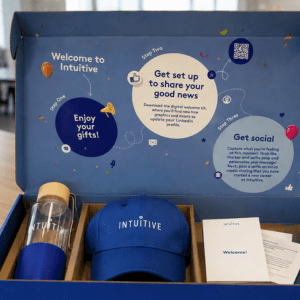
-
-
-
-
-
-
-
-
-
-
-
-
-
- For New Hire or L&D Training Programs, Tie Items Directly to Exercises: Don’t hand out tools passively without referencing them in your training modules, slides, or video demos. Build active scenarios where trainees write on, manipulate, or reference the items live during the module.
- For Onboarding Essentials, Design for Workspace Utility: Choose items that fit naturally into an employee’s daily workflow. If a flowchart desk mat or desk-friendly quick guide stays within arm’s reach, information retention becomes effortless. If it’s printed on the back of a tote bag, it likely won’t aid in recognition or retention.
- For All of Your Training Materials, Avoid Cognitive Clutter: Focus physical tools strictly on a core 2–3 strategic takeaways. Too many props create clutter and dilute the educational focus.
-
-
-
-
-
-
-
-
-
-
-
-
Never deploy educational merchandise in a vacuum; it should always be integrated directly into a structured training or onboarding program. Because company roles and structures constantly evolve, these materials require regular updates to remain relevant and accurate.
Housing educational merchandise alongside other HR swag within a single digital redemption platform creates a unified, scalable hub for your entire workforce. By consolidating these assets, you eliminate administrative friction, simplify fulfillment, and ensure employees always have instant, centralized access to up-to-date resources.
The Retention Matrix: Kitting Educational Swag With Branded Merchandise
Your HR, training, or onboarding merchandise typically falls into two distinct categories based on what you want to achieve. Cultural swag, or branded merchandise, focuses on the human element; making people feel welcomed, connected, and proud to belong to the team. Educational swag focuses on performance; giving employees hands-on tools, quick references, and workflow guides built specifically to help them excel in their day-to-day work.
The most effective way to deploy these educational tools for your critical training programs, especially new hire programs, is to strike a balance: pair welcoming, culture-building items with role-specific educational tools. When a new hire receives a kit that combines a high-quality brand gift with actionable, day-to-day job aids, they do not just feel celebrated; they feel fully equipped to excel.
| Focus Area | Primary Objective | Key Examples | Impact on the Employee |
| Cultural Swag | Welcoming new hires, reinforcing core values, and building team pride. | Premium apparel, custom drinkware, welcome kit notebooks | Belonging: Makes employees feel valued, included, and connected to the broader company mission. |
| Hybrid Tools | Merging brand identity with light daily functionality. | Planners with company milestones, QR-coded journals, goal notebooks | Connection & Utility: Keeps organizational values visible while offering everyday practical value. |
| Educational Swag | Supporting role mastery, process learning, and workflow execution. | Planners with company milestones, QR-coded journals, goal notebooks | Empowerment: Improves information retention and provides instant, job-specific support at the moment of need. |
Striking the right balance between cultural connection and operational utility turns a routine welcome kit into a high-impact learning driver. From the physical gear inside to the custom packaging itself, every touchpoint can be engineered for information retention.
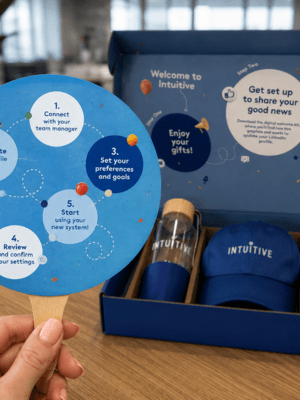
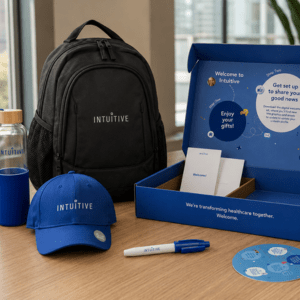
Discover how we helped Intuitive scale their onboarding by pairing premium gifts with custom packaging and QR-enabled educational merch to drive instant productivity.
Turn Your Training Dollars Into Tangible Information Retention Tools
 Physical merchandise is far more than a nice-to-have onboarding perk; it can be used as a science-backed tool to overcome the forgetting curve and drive long-term performance. By transforming passive slides and buried PDFs into tangible, everyday job aids, you give your workforce the continuous visual and tactile cues they need to turn new information into lasting habits.
Ready to Upgrade your Training Programs?
Whether you need to design custom, role-specific learning aids, integrate QR-driven interactive packaging, or deploy a seamless digital redemption portal for your global workforce, our team is here to help you maximize your ROI on every kit.
Contact the BAMKO team today to start building an onboarding and training merchandise strategy that drives real information retention and long-term employee success.
Educational Merchandise & Training Retention FAQ