

For most enterprise procurement teams, branded merchandise is a classic tail spend category. According to standard procurement benchmarks, this long tail typically accounts for 80% of an organization’s supplier base but only 20% of its total spend, creating a high volume of low-value transactions that yield outsized operational headaches.
While custom gear may represent only a fraction of your indirect spend, according to ASI, the promotional products industry has grown into a massive $27.7 billion landscape. Without structural oversight, the underlying risks of this category, ranging from ethical sourcing lapses to volatile international tariffs, can result in severe financial leakage and brand vulnerability.
Why the Traditional Sourcing Model is Broken
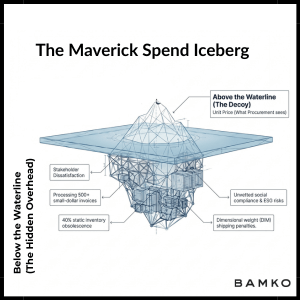 In 2026, enterprise procurement leaders are moving away from transactional “swag vendors” toward vertically integrated partners. The goal is no longer just buying products; it is about reclaiming control over a fragmented, high-risk spend category by overcoming four systemic hurdles:
- Tail Spend Leakage: Branded merchandise typically lives in the “long tail” of unmanaged, small-dollar transactions that bypass core procurement controls. Without consolidation under a Managed Service Provider (MSP), organizations lose 15%–20% in potential cost savings.
- The TCO “Iceberg”: A low unit price is often an illusion. The true Total Cost of Ownership (TCO) includes hidden variables like international freight volatility, 3PL kitting fees, and the “landfill cost” of low-quality goods.
- Maverick Spend & Brand Risk: When localized stakeholders use unvetted brokers or corporate credit cards, they expose the organization to ethical and legal liabilities. Without approved catalogs, compliance is impossible to guarantee.
- Fragile Broker Models: The traditional distributor model is a house of cards. When a middleman outsources to third-party decorators and logistics providers, the audit trail vanishes while markups stack up at every hand-off.
How Procurement Teams Manage Promotional Product Suppliers
Enterprise procurement teams manage promotional product suppliers by consolidating vendors into a single Managed Service Provider (MSP) integrated with their e-procurement systems (like Coupa or SAP). This eliminates tail spend leakage and automates brand compliance.
To effectively manage suppliers at scale, BAMKO replaces vendor fragmentation with a vertically integrated Managed Service model built on three strategic pillars:
Operational Efficiency & Tech Integration
 Managing dozens of localized boutique vendors creates massive administrative friction. BAMKO eliminates this overhead through automated enterprise workflows that seamlessly bridge the gap between marketing requests and procurement controls:
-
-
-
-
-
-
-
-
-
- PunchOut Catalogs & e-Procurement: We integrate directly with systems like Coupa and Oracle, ensuring 100% of merchandise spend is captured within your system of record to eliminate maverick spend at the source.
- Centralized Sourcing Portals: Our proprietary BAMKO CUBE platform allows procurement to standardize RFP processes, access real-time inventory thresholds, and synchronize global pricing via automated PromoStandards API connections.
-
-
-
-
-
-
-
-
Risk Mitigation & Global Resilience
 Relying on a single geographic region or a fragile broker network leaves enterprise brands exposed to severe macro disruptions. BAMKO protects your bottom line through true, proactive supply chain diversification:
-
-
-
-
-
-
-
-
-
- Global Footprint Hedging: Rather than relying on rigid, single-country sourcing strategies, BAMKO has built an active manufacturing network spanning 18+ countries. This expansive footprint allows us to seamlessly shift production based on shifting tariffs, capacity, and regional lead times, ensuring absolute price stability.
- Direct-to-Factory Governance: By cutting out middlemen, brokers, and independent decorators, BAMKO maintains direct, uncompromised relationships with the factories themselves. This offers transparent cost structures and direct, real-time control over production timelines.
-
-
-
-
-
-
-
-
ESG & CSR Compliance
 In 2026, procurement is the ultimate gatekeeper of corporate social responsibility. At BAMKO, compliance isn’t a retroactive audit checklist; it is a non-negotiable prerequisite for entering our supply chain:
-
-
-
-
-
-
-
-
-
- Stringent Vendor Vetting: Every single manufacturing partner in our 18+ country network is rigorously vetted to ensure they meet strict international labor, safety, and environmental benchmarks including EcoVadis, Sedex (SMETA), and the Fair Labor Association (FLA) before a single product is sourced.
- Scope 3 Emissions Reporting: We deliver verifiable data on the carbon footprint of your custom merchandise programs, providing the precise documentation required to help your organization hit its corporate Net Zero targets.
-
-
-
-
-
-
-
-
By embedding tech-driven workflows, a diversified 18+ country manufacturing footprint, and uncompromised compliance standards into a single managed solution, procurement teams no longer have to choose between operational speed and corporate oversight; they get total control over both.
How to Reduce Risk and Ensure Compliance in Merchandise Sourcing
Companies reduce risk in merchandise sourcing by shifting to vertically integrated partners who own their supply chain, eliminating third-party decoration gaps, and proactively diversifying manufacturing across multiple countries to mitigate tariff exposure.
For a global enterprise, a single non-compliant factory in the supply chain is a massive liability. Mature procurement programs protect themselves through total supply chain visibility:
- The Ethical Journey: Procurement must demand proof of ethical sourcing. This requires verifiable data on fair labor practices and environmental standards from the factory floor to the final delivery.
- Bypassing the Middleman Gap: Traditional distributors outsource decoration and fulfillment to third parties, fracturing the audit trail. A vertically integrated partner owns both the decoration facilities and the warehouses, ensuring 100% accountability.
- Proactive Tariff Mitigation: With volatile tariffs impacting global trade, resilient programs require geographic diversity. BAMKO has proactively migrated over 80% of production outside of China into a network of 18 countries to ensure absolute price stability.
- Inventory Hedging: To combat global shipping disruptions, BAMKO offers in-house inventory and decoration models. By pre-purchasing core assets and housing them in strategic global warehouses, enterprise partners are insulated from sudden shipping spikes.
What Procurement Should Look for in a Promotional Products Partner
When vetting a long-term promotional merchandise partner, procurement leaders must look beyond basic catalogs and evaluate infrastructure.
| Sourcing Capability | Standard Merchandise Distributor | Vertically Integrated Partner (BAMKO) | Enterprise Procurement Benefit |
| Sourcing Model | Reliant on third-party catalogs & brokers | 100% Factory-Direct Sourcing | Eliminates middleman markups; direct quality control. |
| Risk Management | Reactive to tariff and supply chain shifts | Proactive (Established 18-country network) | Price stability and continuous global supply resilience. |
| Supply Chain Audit | Multiple unvetted sub-vendors used | Single, fully audited point of contact | Guaranteed ESG, CSR, and fair labor compliance. |
| Technology Integration | Static PDF quotes and manual orders | Real-time ERP, PunchOut, and API integrations | Eradicates maverick spend; automates accounting. |
| Logistics & Warehousing | Domestic shipping focus; outsourced 3PL | Global fulfillment with 2.5M sq. ft. of strategic space | Lower freight costs; seamless international kitting. |
Evaluating a partner based on infrastructure rather than catalog size shifts your strategy from reactive order-taking to proactive risk management. Moving to a vertically integrated model ensures that technology, global resilience, and absolute compliance are natively baked into your program, turning your promotional spend into a transparent, audit-ready operation.
How to Control Costs in Large Promotional Merchandise Programs
Companies control costs in large promotional merchandise programs by focusing on Total Cost of Ownership (TCO). This involves eliminating middleman decoration markups, utilizing retail-quality items to prevent product waste, and leveraging data-driven ROI tracking.
Cost control relies on structural efficiency rather than aggressively squeezing unit prices: true cost containment requires visibility at the source.
- Boots-on-the-Ground Cost Control: BAMKO takes a direct, boots-on-the-ground approach across our primary global sourcing hubs, maintaining dedicated BAMKO locations in key manufacturing regions including China, India, and Brazil. This localized physical presence allows us to negotiate directly with factories, bypass local broker markups, and conduct real-time quality control before goods ever ship.
- Eliminating “Aesthetic Washing”: Procurement teams are prioritizing retail-quality items (like retail-label apparel or premium tech organizers) over disposable commodities. Higher quality means a longer product lifespan and higher perceived value, preventing the wasteful “landfill effect” of cheap, single-use products.
- In-House Decoration Efficiency: Utilizing a partner with in-house decoration capabilities eliminates the double markup on freight and labor that occurs when products are shipped from a primary manufacturer to a separate, third-party decorator.
Ultimately, controlling costs in a large-scale program isn’t about finding the cheapest individual item; it’s about systematically eliminating hidden logistical waste and maximizing the lifetime value of every dollar spent.
Moving Toward Vertical Integration: The BAMKO Approach
The conventional, fragmented approach to sourcing promotional merchandise is no longer viable for the modern enterprise. It is operationally inefficient, unnecessarily expensive, and highly risky.
The BAMKO vertically integrated model ensures we do not just sell products; we own the entire ecosystem. From initial product design and factory-direct sourcing to our 2.5 million square feet of strategic global warehousing, we eliminate the friction, hidden fees, and compliance gaps that typically stall corporate programs.
Is your merchandise supply chain a hidden liability or a competitive advantage?
Connect with a BAMKO strategist today to audit your procurement workflow and secure your brand’s global footprint.
Enterprise Procurement & Supply Chain FAQ